
Access Control for Warehouses in Ontario: What Facility Managers Should Review ?
Warehouses are busy environments with employees, drivers, contractors, deliveries, inventory movement, and after-hours activity happening across multiple entry points. For facility managers in Ontario, access control is not only about locking doors. It is about knowing who can enter, when they can enter, and which areas they should be allowed to access.
A properly planned access control system helps warehouses improve security, reduce unauthorized entry, and manage daily operations more efficiently.
Why Access Control Matters for Warehouses
Warehouse facilities often have more than one access point. Staff entrances, loading docks, inventory rooms, yard gates, office areas, and after-hours doors all need different levels of control.
Without a clear access plan, businesses may face security gaps such as shared keys, uncontrolled dock access, expired employee permissions, or contractors entering restricted areas.
Access control gives facility managers better visibility and control over movement inside and around the building.
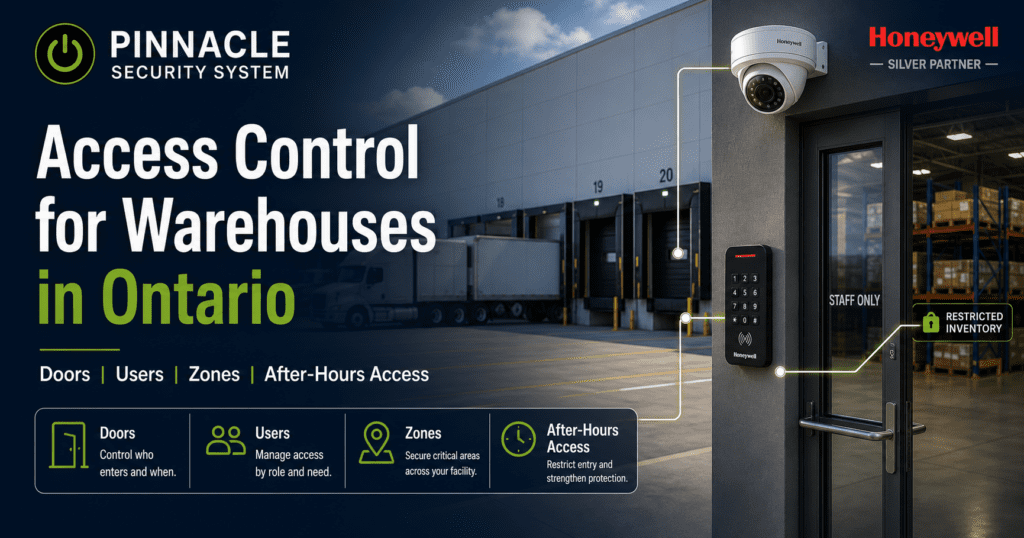
Key Areas Facility Managers Should Review
Staff Entrances
Staff entrances should be reviewed first because they are used every day. Facility managers should confirm who has access, what time schedules are active, and whether former employees or temporary workers still have active credentials.
Access should be based on job role, shift timing, and operational need.
Loading Docks
Loading docks are one of the most important areas in a warehouse. Drivers, suppliers, contractors, and internal staff may all need access at different times.
A good access control plan can help control dock doors, monitor activity, and reduce unauthorized entry during deliveries or after-hours operations.
Restricted Inventory Areas
High-value inventory, tools, records, equipment rooms, and storage areas should not be open to everyone.
Facility managers should review which employees need access to these areas and whether access events are being logged properly. This helps improve accountability and supports internal security procedures.
After-Hours Access
After-hours access is often where security gaps appear. Some employees may need evening or weekend access, but permissions should be carefully reviewed.
Ask these questions:
Who has access after hours?
Which doors can they open?
Are access events being recorded?
Are permissions still valid?
Do supervisors receive reports when needed?
Reviewing after-hours permissions can help reduce unnecessary risk.
Contractors and Temporary Workers
Warehouses often rely on third-party service providers, maintenance contractors, cleaners, and temporary staff.
These users should not have permanent access unless required. Facility managers should consider time-based access, limited-area permissions, and regular reviews of active credentials.
What a Warehouse Access Control Assessment Should Include
A professional access control site assessment should review the full facility layout, including staff doors, dock doors, restricted areas, office spaces, gates, and emergency access points.
The assessment should identify:
- Access points that need control
- Doors currently using keys
- High-risk or restricted areas
- After-hours entry requirements
- User groups and permission levels
- Reporting and audit log needs
- Future expansion requirements
This helps create a practical access control plan that fits the warehouse’s daily operations.
Benefits of Access Control for Ontario Warehouses
A well-designed access control system can help warehouses:
- Reduce unauthorized entry
- Improve employee and contractor access management
- Protect restricted inventory and sensitive areas
- Monitor after-hours activity
- Support safer facility operations
- Replace traditional key management
- Scale as the business grows
For growing Ontario warehouses, scalable access control is especially important because security needs often change as staff, shifts, and operations expand.
Final Thoughts
Access control is not just a security upgrade. It is an operational tool that helps warehouse facility managers understand and manage movement across the building.
By reviewing staff entrances, loading docks, restricted areas, contractor access, and after-hours permissions, warehouses can reduce risk and build a more reliable security plan.
Pinnacle Security System helps Ontario warehouses review access control needs and plan practical solutions for commercial and industrial facilities.